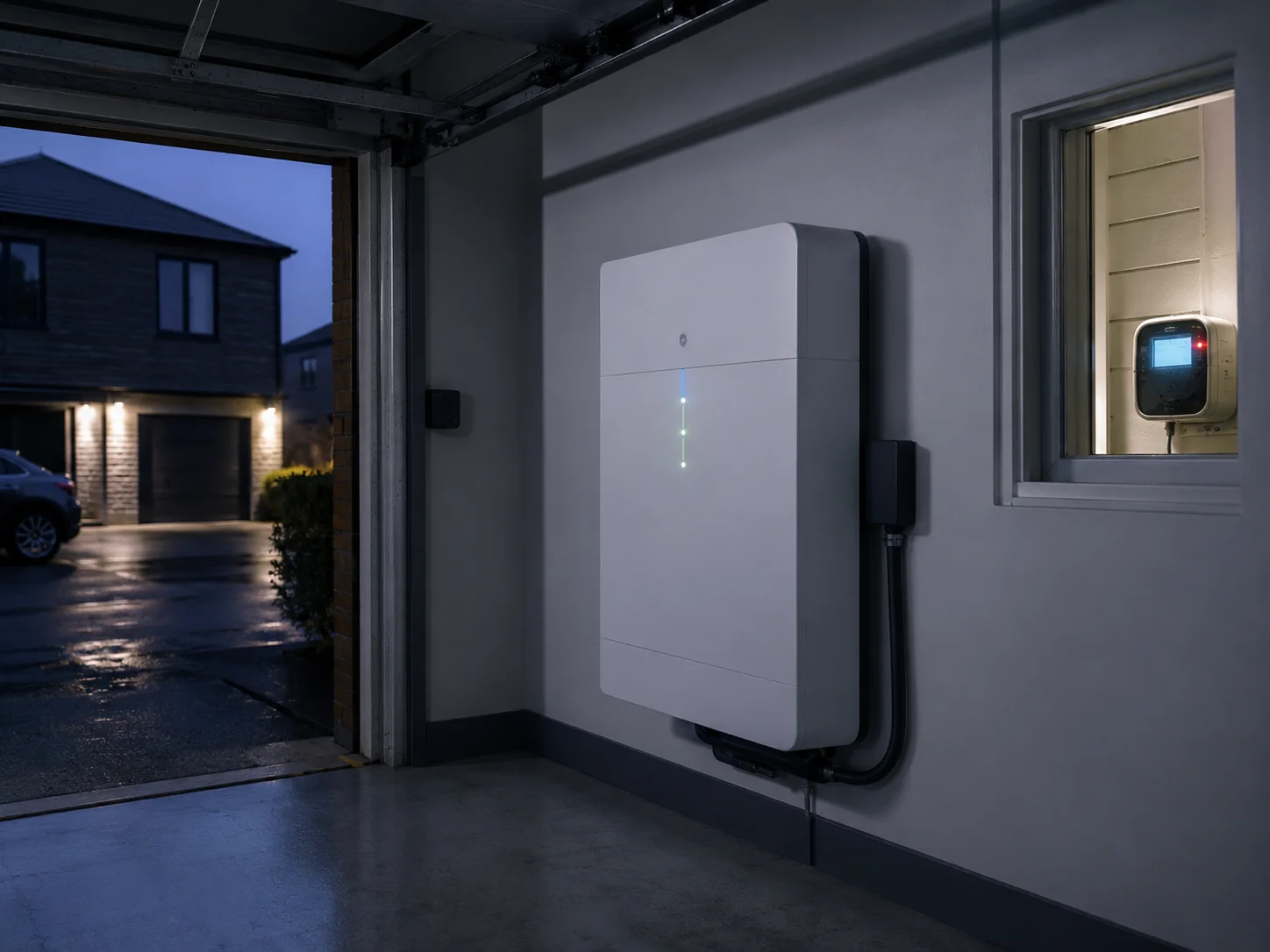
The most expensive thing about your battery isn't what you paid for it. It's how quickly it's wearing out — and why nobody's telling you.
You paid somewhere between £4,000 and £7,000 for your home battery. It came with a warranty, a spec sheet, and a promise of ten to twelve years of service.
Here's what nobody mentioned: how long it actually lasts isn't fixed. It depends heavily on decisions made for you, every day, by software — and most home energy software isn't even trying to make your battery last.
It's quietly wearing out faster than it needs to. And because the damage is spread across thousands of invisible decisions over years, you'll never see it itemised anywhere. There's no line on a bill that says "today cost your battery a little of its life." Just a replacement that arrives earlier than you expected — a five-figure bill, sooner than it needed to come.
This is the most expensive thing about owning a battery that nobody talks about. So let's talk about it.
Two identical batteries. Very different lifespans.
Start with the single most important finding in the research, because it reframes everything.
Researchers at Sandia National Laboratories ran a multi-year study, published in the Journal of the Electrochemical Society in 2020, cycling commercial battery cells under different conditions. Their result should stop every battery owner in their tracks: even when operated entirely within manufacturer specifications, the conditions a battery is used under had a profound effect on how fast it aged — with the time to reach 80% capacity varying by thousands of hours and thousands of cycles between otherwise identical cells.
Same battery. Same spec sheet. Same warranty. One lasts substantially longer than the other — based purely on how it was operated.
Your battery is one of those cells. Which lifespan you get isn't down to luck. It's down to the decisions a control system makes on your behalf, every single day.
Two ways a battery dies — and why "don't discharge it deeply" is the wrong advice
Batteries age two ways at once.
Cycle aging is wear from charging and discharging. Most home batteries today use lithium iron phosphate (LFP) chemistry — durable, typically rated for 3,000 to 6,000 full cycles before capacity drops to 80%.
Calendar aging happens simply with time, driven mainly by temperature and by the charge level the battery is held at.
Now the counterintuitive part. The common advice is "don't discharge your battery too deeply." For the LFP batteries in most modern UK homes, that's not the main lever.
The same Sandia study found that for LFP cells, cycling across a lower average charge level causes less wear than cycling across a higher one — regardless of how deep each discharge goes. At high charge levels, the chemistry degrades faster: the graphite reacts more readily with the electrolyte, accelerating permanent capacity loss. Their conclusion was direct — keeping an LFP battery at a lower average charge can extend its life substantially.
In plain English: a battery that's charged to 100% and left sitting there ages faster than one kept at a healthy middle charge — faster, even, than one cycled hard but kept at a moderate average.
The definitive study on the time-based side — Keil and colleagues at the Technical University of Munich, over 200 cells tested — reinforced it: holding a battery near 100% is where calendar aging accelerates sharply. There's a healthy resting band, and sitting pinned at full charge is the avoidable harm.
What a price-only controller is doing to your battery tonight
Now connect that to how most batteries are actually run.
A battery controlled only by price — a basic tariff timer, or simple "charge when cheap" logic — does the things the research warns against. It charges to 100% in every cheap window and holds there for hours, sitting in the highest-wear state there is. And it round-trips the battery on the smallest price spread imaginable — discharging to save 4p, charging to save 5p — because it has no concept that the cycle itself has a cost.
Every one of those low-value cycles earns you pennies and spends a slice of a multi-thousand-pound asset. The controller thinks it's saving you money. On the things that matter — the genuine cheap-charge, the real peak-discharge — it is. But it's also quietly burning down the hardware to chase savings so small they barely exist.
You never see that trade. That's the whole problem. The saving shows up. The cost doesn't.
What it's worth — a way to think about it
It helps to put rough numbers on the idea. These are purely illustrative — a way to see the shape of the trade, not a measured result — and your own figures will differ.
Take a £6,000 battery you'd hope to keep for around ten years. Loosely, that's in the region of £600 of value consumed per year — ticking down whether you notice or not.
The research is clear that operating conditions, within spec, can swing a battery's working life by years. So if careless price-only cycling brought a replacement forward even modestly, the value at stake isn't trivial — it's measured in hundreds of pounds a year of asset life, against daily cycling that may have earned only a few pounds a month. The point isn't a precise figure. It's the direction: a controller optimising purely for tonight's bill can destroy more value in hardware than it creates in savings, and never show you the difference.
That's the trade no price-only system surfaces. And it's the one we decided Aveum should stop making.

What we changed — and why it matters beyond batteries
We've added battery wear as a real, costed factor inside Aveum's optimisation engine, and it's live now.
Every time the engine considers an action involving your battery — charging, discharging, or holding at a charge level — it calculates the genuine wear cost of that action, built directly on the research above: throughput-based cycle aging, an added penalty for sitting at high average charge, and time-based aging that climbs steeply near full. That wear cost sits alongside price and carbon as a real cost in every decision.
It's always on. It applies whether you're optimising for savings, for carbon, or for a balance — because battery wear is money you lose no matter what you're optimising for.
This is also the part worth understanding about how Aveum is built. Battery health is the third objective our engine optimises for, after cost and carbon — and it slotted in cleanly because the engine was designed from the start to weigh multiple real-world costs against each other in a single decision, every 30 minutes. Cost. Carbon. Now hardware longevity. Each one makes every decision a little wiser, and the architecture absorbs new objectives rather than bolting them on. That's the difference between an app with features and a coordination engine that compounds.
And here's what we tested hardest, because it's the thing that matters: it does not cost you savings. The wear cost of a typical action is a fraction of a penny per unit of energy — far below a real price spread of tens of pence. So every genuine opportunity still wins. Charge cheap, discharge into the peak, capture the saving: all preserved, exactly as before.
What changes is only at the margin — and the margin is where the damage was happening. When the engine would previously have round-tripped your battery on a 5p spread, it now recognises that cycle isn't worth the wear and leaves the battery alone. When a full charge isn't needed for the day ahead, it stops filling to 100% out of habit. When two options are otherwise equal, it picks the one that keeps your battery healthier.
On a representative day in our own testing, removing that low-value churn didn't just protect the battery — the import bill actually fell, because the churn was never really saving anything. Less pointless work, a lower bill, and hardware that lasts longer. Not a trade-off. The same decision.
The bottom line
Your battery's lifespan was never fixed. The research is unambiguous: identical batteries last very different lengths of time depending purely on how they're run — and the biggest controllable lever is one that software either manages or ignores.
Almost all of it ignores it, optimising for the cheapest bill tonight while silently spending down the most expensive piece of hardware in your home.
We decided that's the wrong way to optimise. Aveum now protects the cheapest bill and the longest hardware life together — because, done properly, those were never two goals. They're one.
The battery you already own deserves to be treated like the asset it is.
Fix it with Aveum
Aveum coordinates timing across your battery, EV charger, heat pump, and tariff signals so your home runs in the cheapest and highest-value windows.
Get early access